Simplagents vs CustomGPT for Website Chatbots
Created: 23/05/2026
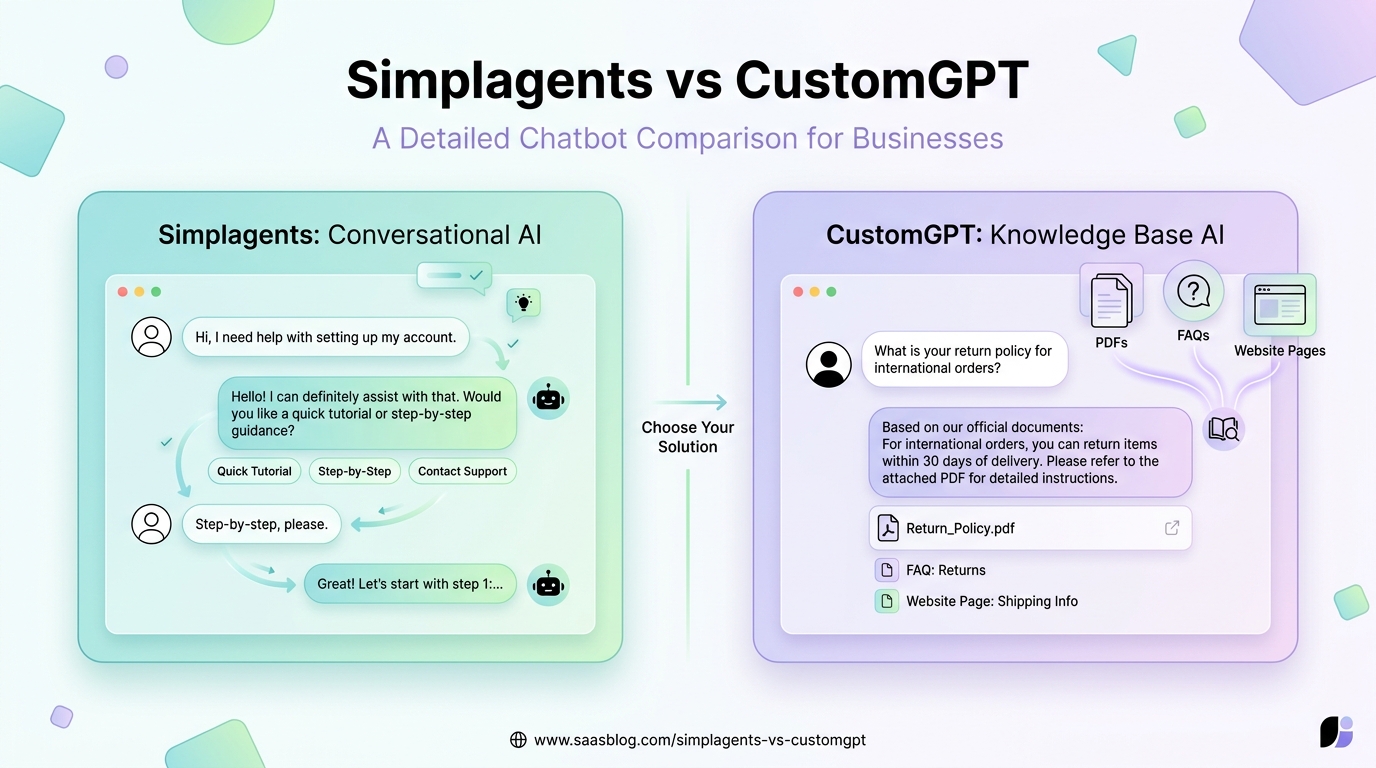
A lot of AI chatbot tools promise the same thing.
Upload your content.
Train the bot.
Add it to your website.
But once businesses actually start using these tools, the differences become clear very quickly.
Some chatbots feel like search engines with chat bubbles.
Others feel more conversational and easier for visitors to interact with.
That is where Simplagents and CustomGPT take different approaches.
Both platforms help businesses create AI chatbots for websites, but the overall chatbot experience feels different depending on the type of interaction you want.
What CustomGPT Does Well
CustomGPT focuses strongly on AI knowledge-based chatbots.
Businesses can upload:
• PDFs
• Help docs
• Website pages
• Internal knowledge
• FAQs
The chatbot then responds using that uploaded information.
That setup works well for:
• Documentation support
• Internal knowledge assistants
• FAQ automation
• Customer support portals
Example:
A software company uploads product documentation and tutorials. Customers can ask technical questions instead of searching through long help articles.
For support-focused teams, this setup saves time.
Where Knowledge Based Bots Feel Limited
Many AI support bots work well when users ask direct questions.
But conversations become weaker when visitors:
• Need guidance
• Are unsure what to ask
• Want recommendations
• Need help choosing
• Prefer natural conversation
The chatbot often switches into information retrieval mode instead of conversation mode.
That difference matters on websites focused on engagement and lead generation.
Why Simplagents Chatbots Feel More Interactive
Simplagents focuses more on conversational interaction instead of only answering from stored knowledge.
The chatbot feels designed for dialogue.
Instead of waiting for perfect user questions, the chatbot can guide conversations naturally step by step.
Example:
A visitor lands on a marketing agency website and types:
“I need help growing my business.”
A conversational chatbot can continue with:
• What type of business do you run?
• Are you focused on leads or sales?
• What marketing channels are you using currently?
• What is your biggest challenge right now?
The experience feels smoother than a typical FAQ chatbot.
Better for Website Engagement
A lot of website visitors do not arrive with fully formed questions.
They browse.
They explore.
They hesitate.
A conversational chatbot helps continue the interaction naturally.
That is especially useful for:
• Agencies
• SaaS companies
• E-commerce stores
• Service businesses
• Lead generation websites
The chatbot becomes part of the website experience instead of acting like a support widget.
Easier for Non Technical Visitors
Knowledge-based bots often work best when users know exactly what they need.
Conversational chatbots reduce that friction.
Example:
Instead of typing:
“Do you offer onboarding for teams under 10 people?”
A visitor may simply say:
“We are a small team.”
The chatbot can continue the conversation naturally without requiring highly specific queries.
Which One Should You Choose?
Choose CustomGPT if:
• Your focus is document-based support
• You want AI trained on company knowledge
• You mainly need FAQ automation
• Your users ask direct support questions
Choose Simplagents if:
• You want conversational website interactions
• You care about visitor engagement
• You want guided chatbot conversations
• You want chat experiences that feel more natural
• You want website visitors to interact longer instead of only searching for answers
Final Thoughts
Most AI chatbot tools today can answer questions from uploaded content.
That part is becoming standard.
The bigger difference now is how the chatbot handles conversation.
Some tools focus mainly on retrieval.
Others focus more on interaction.
If your website mainly needs a knowledge assistant, CustomGPT can work well.
But if you want chatbot conversations that feel smoother, more engaging, and more natural for visitors, Simplagents offers a more conversation-focused experience.